How I used Goldratt's Evaporating Cloud to decide on my Easter flights
I needed to book flights home to Portugal for Easter. Berlin → Porto, departing March 31. The only open question: return April 7 or April 11?
The price difference was negligible — about €10-20 across most options. This wasn’t a money problem. It was a priorities problem disguised as a logistics one.
The data
I pulled flight options across both return dates and both Porto and Lisbon:
| Route | Apr 7 return | Apr 11 return |
|---|---|---|
| Porto — best value (via Amsterdam) | €289, 4h40 | €298, 4h40 |
| Porto — nonstop | €343, 3h20 | €359, 3h20 |
| Lisbon — best option | €338, 5h30 | €341, 7h25 |
Porto was cheaper across the board. The sweet spot was the via-Amsterdam option — reasonable duration, single connection. Price wasn’t going to decide this.
The real question
I’ve been living in Berlin, away from family and friends in Portugal. This trip wasn’t just a holiday — it was about reconnecting. Having laughs. Feeling home.
But some part of me felt like I “should” come back earlier. Stay disciplined. Keep the rhythm going.
So I had a classic conflict: spend more time with the people I miss, or come back and get back to work?
That’s when I reached for a thinking tool from Eliyahu Goldratt’s It’s Not Luck — the Evaporating Cloud.
The Evaporating Cloud
The Evaporating Cloud (also called the Conflict Resolution Diagram) is a tool from the Theory of Constraints. It makes conflicts explicit — not to pick a winner, but to find the hidden assumptions that make the conflict feel real. Break an assumption, and the conflict evaporates.
Here’s how mine looked:
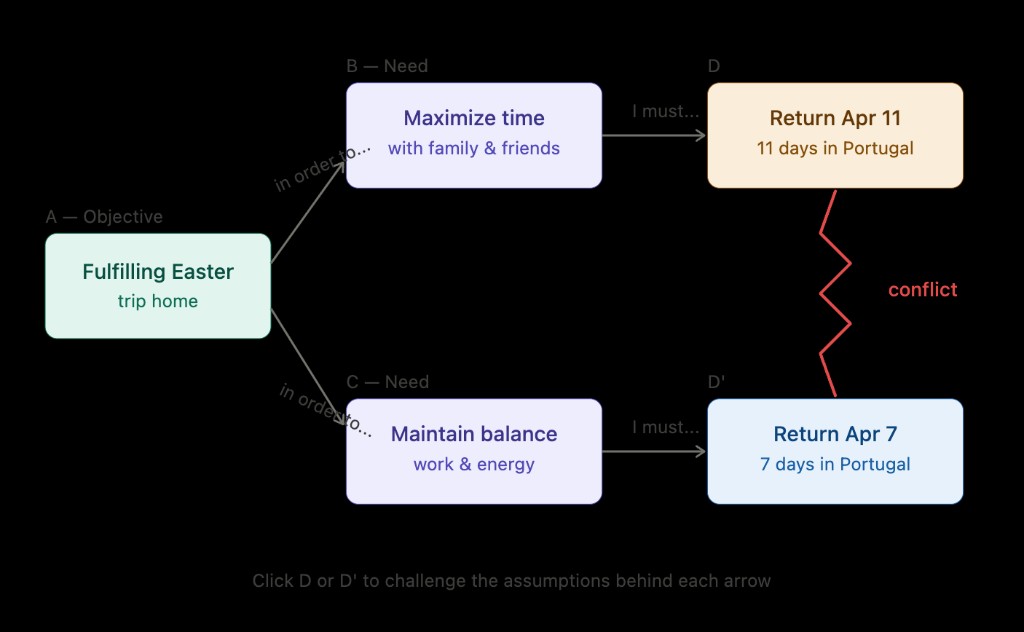
The conflict sits between D and D’ — I can’t return on both dates. But the cloud isn’t about choosing a side. It’s about challenging the arrows.
Challenging the assumptions
Each arrow carries hidden assumptions. The technique works by surfacing them and asking: are they valid?
B → D: “To maximize time with people, I must stay until Apr 11.”
Is that true? Generally yes — more days means more chances to see people. Not every assumption is wrong.
C → D’: “To maintain my balance, I must return Apr 7.”
This is where it got interesting. I asked myself: what’s actually waiting for me on Apr 7? No client work. No commitments. Easter week is quiet. The “should” had no substance behind it.
And then the real insight: the absence of friends and connection was already disturbing my rhythm more than 4 extra days away ever could.
The cloud evaporates
The C → D’ arrow broke. There was no real reason to come back early — just a vague sense of obligation. The conflict between D and D’ disappeared because one side had nothing holding it up.
Decision: Return April 11. Book the via-Amsterdam option at €298.
The takeaway
The Evaporating Cloud works because most conflicts aren’t real trade-offs — they’re built on assumptions we haven’t examined. The technique doesn’t tell you which side to pick. It asks: do you actually have to pick?
In this case, I didn’t. I just had to notice that one side of my conflict was made of air.
If you’re stuck deciding something, try drawing an Evaporating Cloud. Map the conflict, challenge each arrow — you might find the choice evaporates too.
For much richer examples, pick up It’s Not Luck. Goldratt’s novel follows Alex Rogo — the same protagonist from The Goal — who’s promoted to exec at UniCo and told to turn around three acquired companies. Success means they get sold and he loses his job; failure means closures. It’s a lose-lose setup, and the Evaporating Cloud drives the entire story.